
Detecting defects in conductive graphite using voltage measurements
DOI:
https://doi.org/10.64804/mzrrdy95Keywords:
electric potential, non-destructive testing, graphite conductor, voltage mapping, defect detection, conductive medium, electric field, resistance, discontinuity, circuit reliabilityAbstract
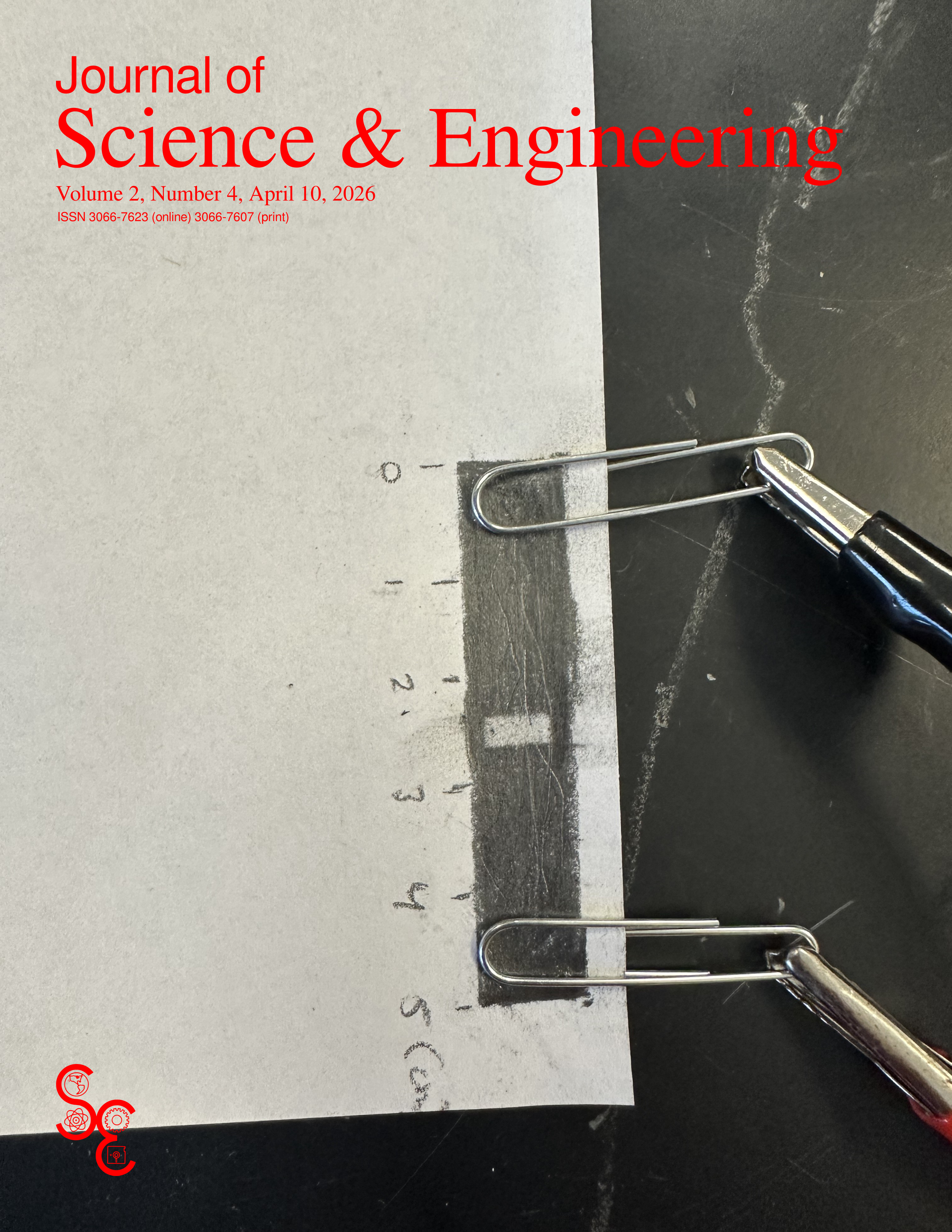
Non-destructive testing (NDT) methods are critical for evaluating the reliability of mechanical components without damaging them. This is especially useful for applications like 3D printed metal and conductive parts, circuit testing, and detecting faults in electrical components. In this experiment, we use a uniform graphite surface from a No. 2 pencil to simulate a continuous 3D printed metal layer. A 9 V battery supplied an electric current through the graphite conductive medium and the voltage was measured at multiple points of the surface. A defect was mimicked on the graphite by erasing a rectangular portion of the graphite, and voltage was measured. For the uniform surface, voltage changed approximately linearly with distance, while the surface containing a defect showed a quick change in voltage at the gap. These results demonstrate that voltage measurements can be used to detect defects in conductive materials, supporting their application in non-destructive testing.
References
J. R. Davis, Non-Destructive Evaluation of Materials. Materials Park, OH: ASM International, 2004.
P. Cawley, “Non-destructive testing—current capabilities and future directions,” Proceedings of the Institution of Mechanical Engineers, Part L: Journal of Materials: Design and Applications, vol. 215, pp. 213–223, 2001. DOI: https://doi.org/10.1177/146442070121500403
M. H. Loke, J. E. Chambers, D. F. Rucker, O. Kuras, and P. B. Wilkinson, “Recent developments in the direct-current geoelectrical imaging method,” Journal of Applied Geophysics, vol. 95, pp. 135–156, 2013. DOI: https://doi.org/10.1016/j.jappgeo.2013.02.017
A. Hauptmann, M. Ikehata, H. Itou, and S. Siltanen, “Revealing cracks inside conductive bodies by electric surface measurements,” Inverse Problems, vol. 35, p. 025004, 2018. DOI: https://doi.org/10.1088/1361-6420/aaf273
S. Ayyagari, V. Collemi, K. Shah, and K. Tomazic, “Computational mapping analysis of equipotential and electric field lines in gel electrophoresis rig,” Journal of Science & Engineering, vol. 1, pp. 37–40, 2024. DOI: https://doi.org/10.64804/ekds4s10
S. Baru, V. Choudhary, P. Thaker, N. Martin, and D. Ahmad, “Demonstrating a method to create a low-cost electrophoresis rig solution,” Journal of Science & Engineering, vol. 1, pp. 42–44, 2024. DOI: https://doi.org/10.64804/7jata907
R. Cohen, S. Musuku, J. Hammer, E. Handique, N. Patel, D. Gandhi, and N. Gershteyn, “Visualizing electric potential: mapping equipotential lines in a conductive water tray,” Journal of Science & Engineering, vol. 1, pp. 45–47, 2024. DOI: https://doi.org/10.64804/8gy8pg59
R. Edwards, C. Karabin, C. Li, K. Patel, and J. Schatz, “Electric field mapping for cost-effective gel electrophoresis applications,” Journal of Science & Engineering, vol. 1, pp. 49–52, 2024. DOI: https://doi.org/10.64804/tf7dzw46
A. Kumar, S. Perkins, N. Muthukumar, H. Villaseñor, and A. Khanna, “Mapping electric potential and electric field distribution in saltwater and investigating the effect of distance from source,” Journal of Science & Engineering, vol. 1, pp. 53–55, 2024. DOI: https://doi.org/10.64804/7g8ed745
National Institute of Standards and Technology (NIST), “Electrical conductivity of graphite materials,” https://webbook.nist.gov/cgi/cbook.cgi?ID=C7782425, 2026, accessed: Mar 2026.
D. J. Griffiths, Introduction to Electrodynamics, 4th ed. Boston, MA: Pearson Education, 2013.
C. Kittel, Introduction to Solid State Physics, 8th ed. Hoboken, NJ: Wiley, 2004.
C. R. Nave, “Doing it by the numbers: Javascript calculations in web-based instructional material,” in AAPT Summer Meeting, Guelph, Ontario, 2000, http://hyperphysics.phy-astr.gsu.edu/hbase/electric/equipot.html
P. A. Tipler and G. Mosca, Physics for Scientists and Engineers, 5th ed. New York: W H Freeman and Company, 2004.
R. A. Pelcovits and J. Farkas, Barron’s AP Physics C Premium. Fort Lauderdale, FL: Kaplan North America, 2024.
W. Moebs, S. J. Ling, and J. Sanny, University Physics. Houston, TX: OpenStax, 2016, vol. 1.
R. D. Knight, Physics for Scientists and Engineers: a strategic approach, 4th ed. Pearson, 2017.
J. D. Jackson, Classical Electrodynamics, 3rd ed. John Wiley & Sons, 1999. DOI: https://doi.org/10.1119/1.19136
R Core Team, R: A Language and Environment for Statistical Computing, R Foundation for Statistical Computing, Vienna, Austria, 2025. [Online]. Available: https://www.R-project.org/
H. Wickham, ggplot2: Elegant Graphics for Data Analysis. Springer-Verlag New York, 2016. [Online]. Available: https://ggplot2.tidyverse.org DOI: https://doi.org/10.1007/978-3-319-24277-4_9
Downloads
Published
Data Availability Statement
Data and code are available at https//github.com/devangel77b/426ccanada-lab10
Issue
Section
License
Copyright (c) 2026 Journal of Science & Engineering

This work is licensed under a Creative Commons Attribution-NonCommercial 4.0 International License.
How to Cite