
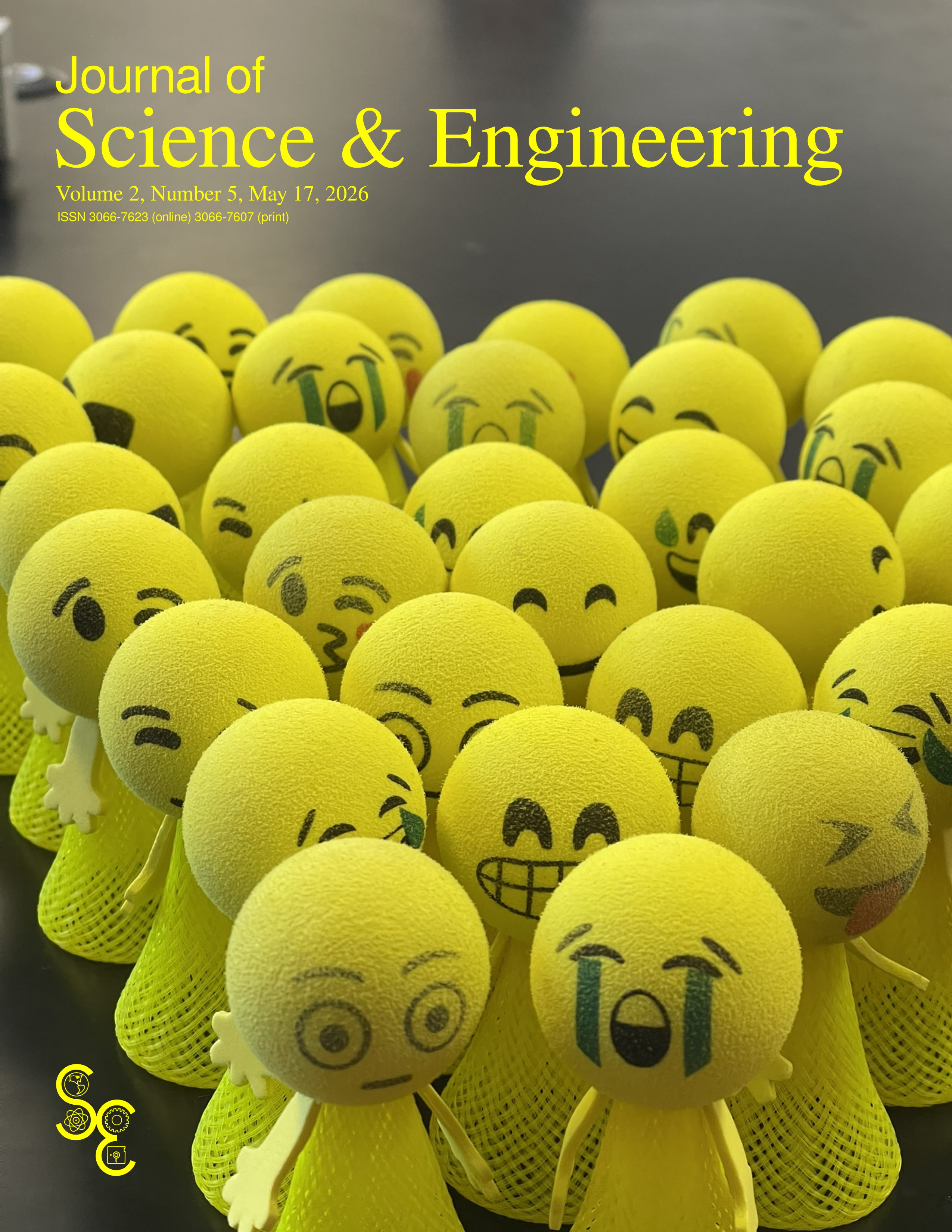
Non-conservation of mechanical energy in spring-launching toy poppers
DOI:
https://doi.org/10.64804/rbrn1c37Keywords:
elastic potential energy, energy conservation, kinetic energy, potential energy, conservation of energy, mechanical energy, popperAbstract
The law of conservation of mechanical energy states that, in an isolated system, mechanical energy remains constant as energy transforms between its kinetic and potential form without loss. This experiment investigates if energy is conserved in a 0.0055 kg spring-launching toy popper. When compressed, the toy stores elastic potential energy that is then converted to kinetic energy as the toy is released. The kinetic energy is then converted to gravitational potential energy as the toy ascends. A two-tailed paired t-test comparing the initial kinetic energy and gravitational potential energy at maximum height across ten repeated trials of the same popper yielded a statistically significant difference from zero. This result appears to suggest that mechanical energy was not fully conserved, but a more likely explanation is that we did not account for the presence of non-conservative forces such as air resistance during launch.
References
P. A. Tipler and G. Mosca, Physics for Scientists and Engineers, 5th ed. (W H Freeman and Company, New York, 2004).
R. A. Pelcovits and J. Farkas, Barron’s AP Physics C Premium (Kaplan North America, Fort Lauderdale, FL, 2024).
W. Moebs, S. J. Ling, and J. Sanny, University Physics, Vol. 1 (OpenStax, Houston, TX, 2016).
P. P. Urone and R. Hinrichs, College Physics 2e (OpenStax, Houston, TX, 2022).
R Core Team, R: A Language and Environment for Statistical Computing, R Foundation for Statistical Computing, Vienna, Austria (2025).
H. Wickham, ggplot2: Elegant Graphics for Data Analysis (Springer-Verlag New York, 2016). DOI: https://doi.org/10.1007/978-3-319-24277-4_9
H. Wickham, R. François, L. Henry, K. Müller, and D. Vaughan, dplyr: A Grammar of Data Manipulation (2026), R package version 1.2.0.
Downloads
Published
Data Availability Statement
Data and analysis code are available at https://github.com/devangel77b/427tchung-lab3
Issue
Section
License
Copyright (c) 2026 Journal of Science & Engineering

This work is licensed under a Creative Commons Attribution-NonCommercial 4.0 International License.
How to Cite