
Detecting flaws in metal by mapping equipotentials on a two-dimensional graphite model
DOI:
https://doi.org/10.64804/6hz16085Keywords:
equipotentials, two-dimensional, voltage, electric potential, electric field, graphite, three-dimensional (3-D), two-dimensional (2-D), non-destructive testingAbstract
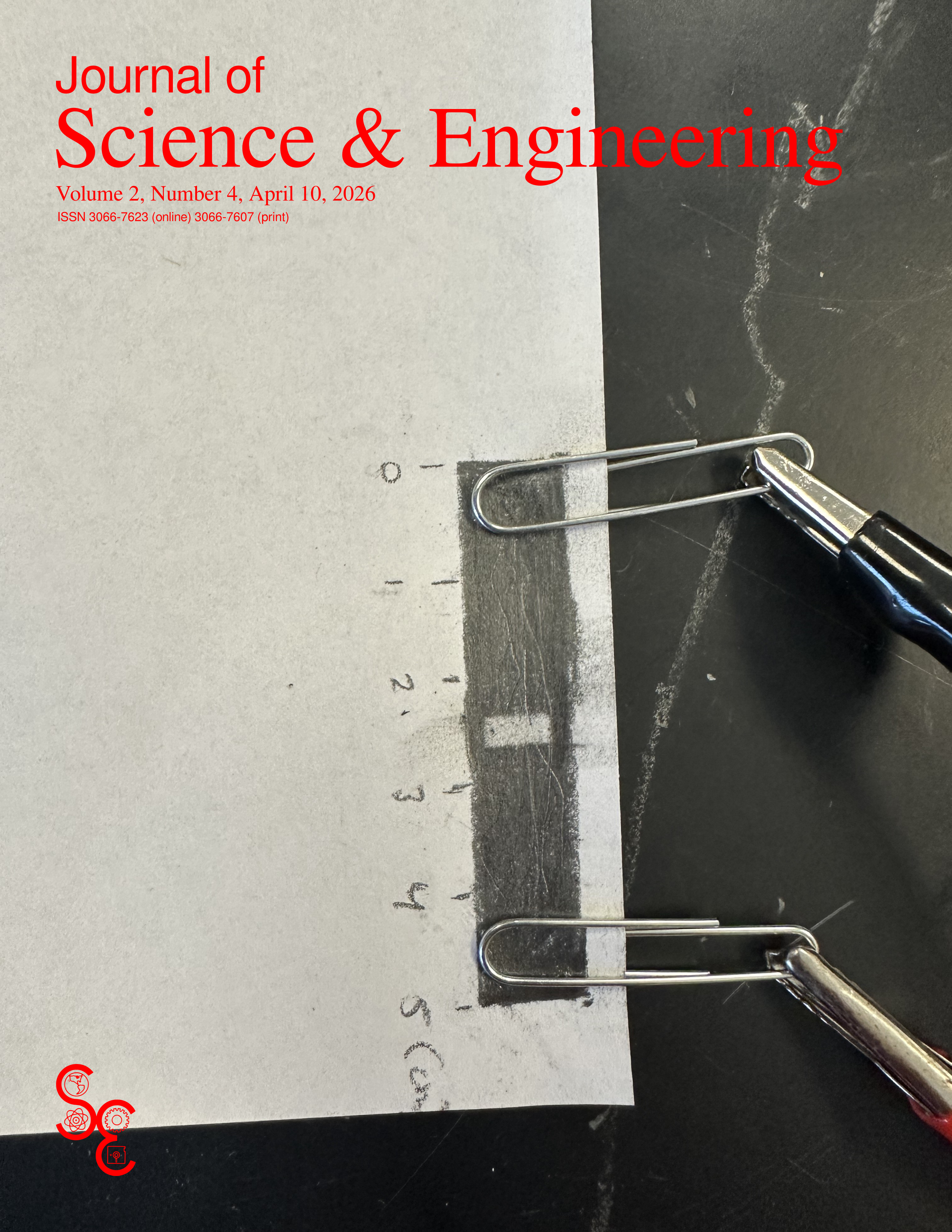
With the popularization of 3-D (three-dimensional) printed metals, the necessity for a method to detect internal flaws is increasing. We experimented with a 2-D (two-dimensional) graphite model of 3-D printed metal and measured the potential at various points throughout the model in a grid-like fashion. To simulate imperceptible flaws, we erased internal portions of the graphite and re-measured the potentials at the same points. Graphing our measurements, we created representations of nonlinear potential differences, allowing us to conclude that calculating potential in intervals over a conducting surface is a valid method to detect imperfections hidden within 3-D printed conducting surfaces under certain conditions.
References
P. A. Tipler and G. Mosca, Physics for Scientists and Engineers, 5th ed. New York: W H Freeman and Company, 2004.
R. A. Pelcovits and J. Farkas, Barron’s AP Physics C Premium. Fort Lauderdale, FL: Kaplan North America, 2024.
W. Moebs, S. J. Ling, and J. Sanny, University Physics. Houston, TX: OpenStax, 2016, vol. 1.
C. R. Nave, “Doing it by the numbers: Javascript calculations in web-based instructional material,” in AAPT Summer Meeting, Guelph, Ontario, 2000, http://hyperphysics.phy-astr.gsu.edu/hbase/electric/equipot.html.
R. D. Knight, Physics for Scientists and Engineers: a strategic approach, 4th ed. Pearson, 2017.
S. Ayyagari, V. Collemi, K. Shah, and K. Tomazic, “Computational mapping analysis of equipotential and electric field lines in gel electrophoresis rig,” Journal of Science & Engineering, vol. 1, pp. 37–40, 2024. DOI: https://doi.org/10.64804/ekds4s10
S. Baru, V. Choudhary, P. Thaker, N. Martin, and D. Ahmad, “Demonstrating a method to create a low-cost electrophoresis rig solution,” Journal of Science & Engineering, vol. 1, pp. 42–44, 2024. DOI: https://doi.org/10.64804/7jata907
R. Cohen, S. Musuku, J. Hammer, E. Handique, N. Patel, D. Gandhi, and N. Gershteyn, “Visualizing electric potential: mapping equipotential lines in a conductive water tray,” Journal of Science & Engineering, vol. 1, pp. 45–47, 2024. DOI: https://doi.org/10.64804/8gy8pg59
R. Edwards, C. Karabin, C. Li, K. Patel, and J. Schatz, “Electric field mapping for cost-effective gel electrophoresis applications,” Journal of Science & Engineering, vol. 1, pp. 49–52, 2024. DOI: https://doi.org/10.64804/tf7dzw46
A. Kumar, S. Perkins, N. Muthukumar, H. Villaseñor, and A. Khanna, “Mapping electric potential and electric field distribution in saltwater and investigating the effect of distance from source,” Journal of Science & Engineering, vol. 1, pp. 53–55, 2024. DOI: https://doi.org/10.64804/7g8ed745
D. J. Griffiths, Introduction to Electrodynamics, 4th ed. Boston, MA: Pearson Education, 2013.
C. Kittel, Introduction to Solid State Physics, 8th ed. Hoboken, NJ: Wiley, 2004.
N. Forrester, “Researcher unveil new AI-driven method for improving additive manufacturing,” https://www.anl.gov/article/researchers-unveil-new-aidriven-method-for-improving-additive-manufacturing, 2023.
M. H. Loke, J. E. Chambers, D. F. Rucker, O. Kuras, and P. B. Wilkinson, “Recent developments in the direct-current geoelectrical imaging method,” Journal of Applied Geophysics, vol. 95, pp. 135–156, 2013. DOI: https://doi.org/10.1016/j.jappgeo.2013.02.017
A. Hauptmann, M. Ikehata, H. Itou, and S. Siltanen, “Revealing cracks inside conductive bodies by electric surface measurements,” Inverse Problems, vol. 35, p. 025004, 2018. DOI: https://doi.org/10.1088/1361-6420/aaf273
Downloads
Published
Data Availability Statement
Data and code are available at https://github.com/devangel77b/426cbutash-lab10
Issue
Section
License
Copyright (c) 2026 Journal of Science & Engineering

This work is licensed under a Creative Commons Attribution-NonCommercial 4.0 International License.
How to Cite