
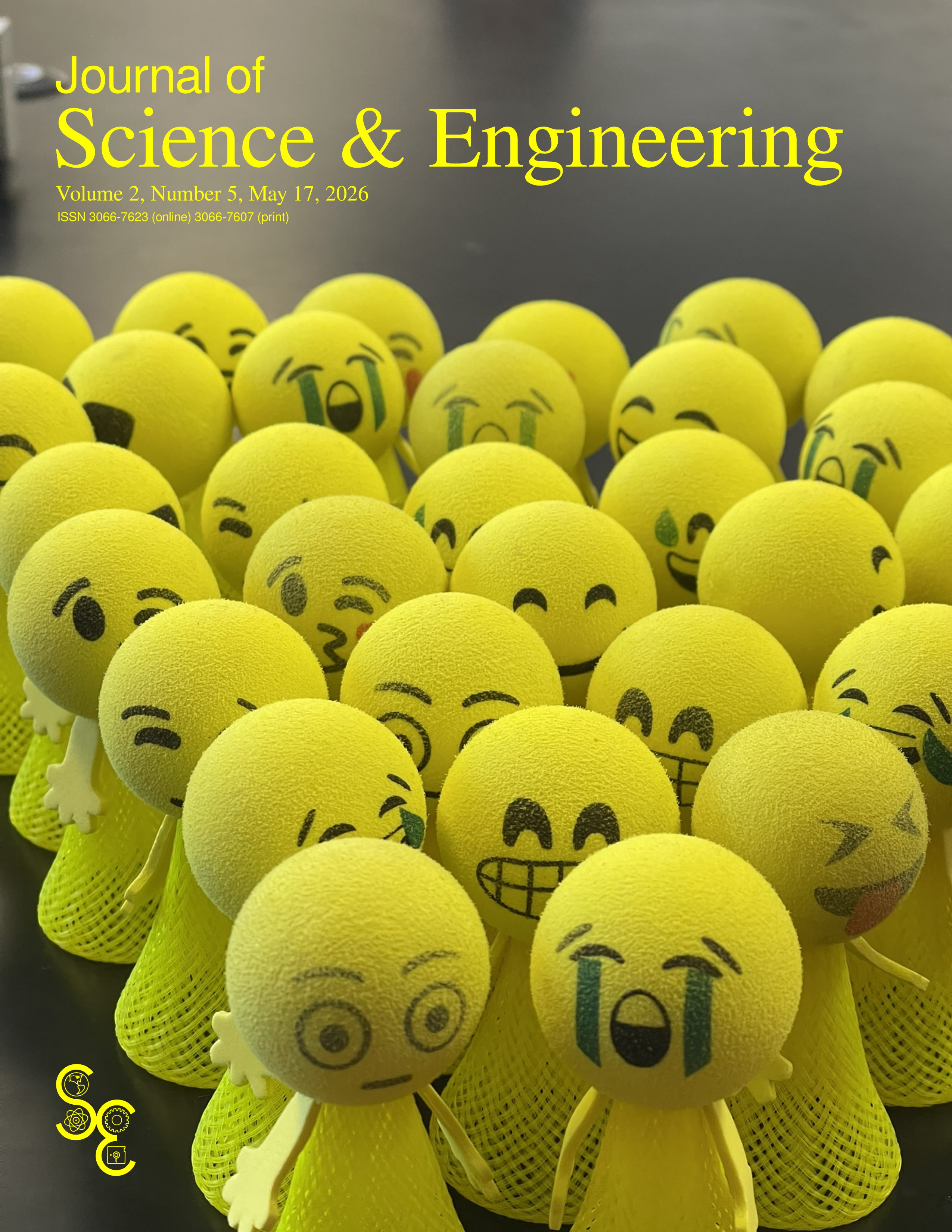
Energy is conserved in spring-like poppers
DOI:
https://doi.org/10.64804/csnmd731Keywords:
energy, kinetic energy, energy conservation, potential energy, spring, poppers, physics, mechanicsAbstract
This experiment investigates energy conservation in spring-like popper toys. A popper was compressed and released to obtain its maximum height, its velocity right after hitting the maximum height, and its velocity upon release for five trials. The kinetic energy equation and the potential energy equation were evaluated with the obtained values, where the average of the yielded kinetic energy and potential energy values, 0.068 94 J and 0.079 22 J, respectively, were compared and found to be approximately equal. The elastic potential energy stored in the popper before launch was 0.257 J, further supporting the idea that energy is conserved. A paired t-test comparing the average kinetic energy at launch and the average gravitational potential energy at maximum height for a popper for five trials yielded p = 0.424, revealing no statistically significant difference between the kinetic energy at launch and the potential energy at the popper’s highest point. This means that the kinetic energy at launch and the potential energy at maximum height are close enough to be comparable, further supporting the idea that energy is conserved.
References
P. A. Tipler and G. Mosca, Physics for Scientists and Engineers, 5th ed. (W H Freeman and Company, New York, 2004).
R. A. Pelcovits and J. Farkas, Barron’s AP Physics C Premium (Kaplan North America, Fort Lauderdale, FL, 2024).
W. Moebs, S. J. Ling, and J. Sanny, University Physics, Vol. 1 (OpenStax, Houston, TX, 2016).
N. Badmin, A. Dolgin, J. Khabinskiy, K. Koping, and E. Pechersky, Investigation of free fall using bottles of water and rocks, Journal of Science & Engineering 2, 32 (2026). DOI: https://doi.org/10.64804/ba7cpz93
C. Chazot and U. Delabre, Using smartphones to perform kinematic analysis in sports with the FizziQ app: example of the pole vault, The Physics Teacher 63, 791 (2025). DOI: https://doi.org/10.1119/5.0174195
R Core Team, R: A Language and Environment for Statistical Computing, R Foundation for Statistical Computing, Vienna, Austria (2025).
H. Wickham, ggplot2: Elegant Graphics for Data Analysis (Springer-Verlag New York, 2016). DOI: https://doi.org/10.1007/978-3-319-24277-4_9
H. Wickham, R. François, L. Henry, K. Müller, and D. Vaughan, dplyr: A Grammar of Data Manipulation (2026), R package version 1.2.0.
Downloads
Published
Data Availability Statement
Data are available at https://docs.google.com/spreadsheets/d/1fo2NcZXgfWAaHf1r0FTBUUQ7TVVSQs0S9sgPe3v7Mkw/edit?gid=0#gid=0 and https://github.com/devangel77b/427ksu-lab3
Issue
Section
License
Copyright (c) 2026 Journal of Science & Engineering

This work is licensed under a Creative Commons Attribution-NonCommercial 4.0 International License.
How to Cite