
Testing the independence of gravitational acceleration from mass: a comparative analysis of free-falling objects near Earth’s surface
DOI:
https://doi.org/10.64804/bbdgcp59Keywords:
physics, acceleration, kinematics, gravitational acceleration, bowling ball, baseball, free fall, Galileo, Aristotle, Tracker, R, ggplot2, dplyrAbstract
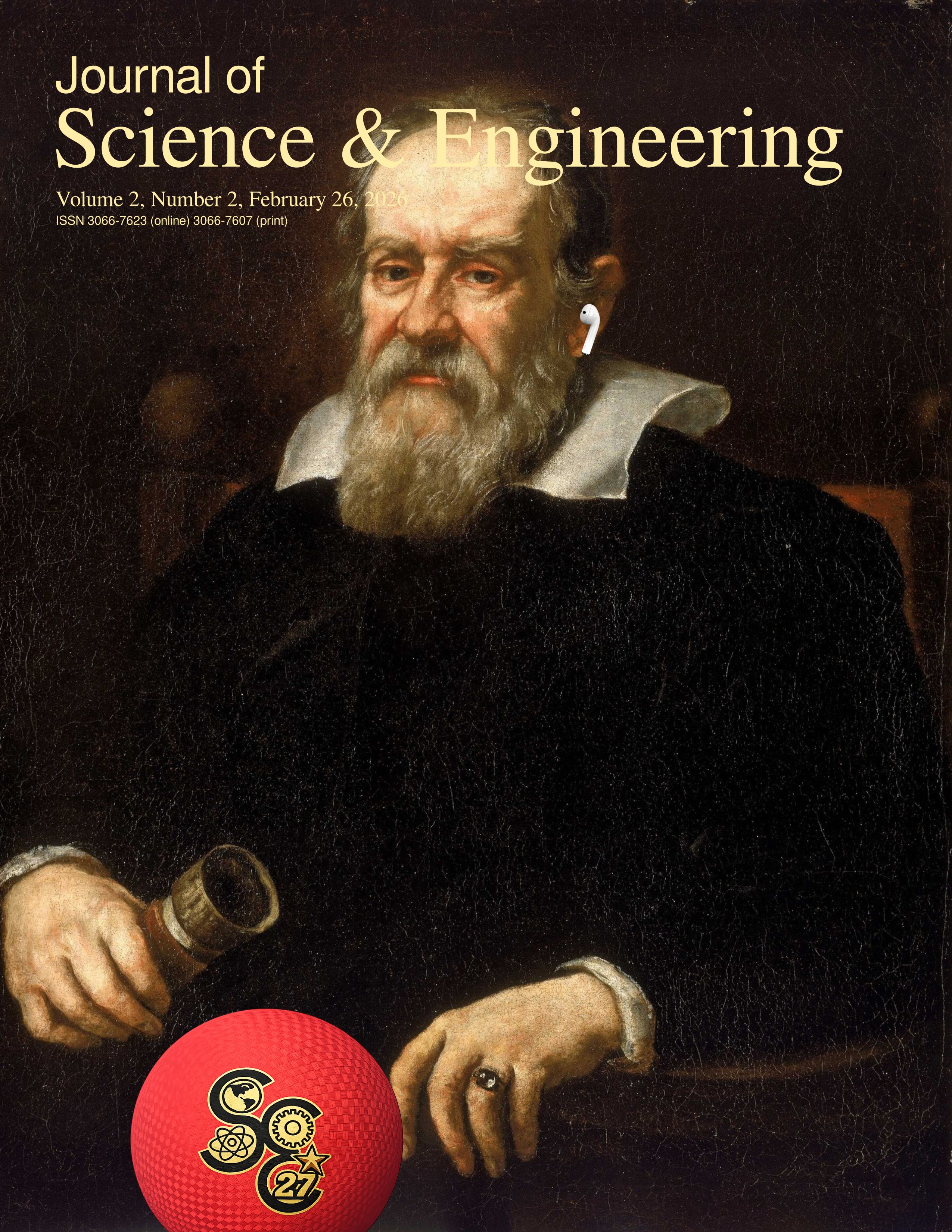
The goal of this experiment was to determine whether mass affects the acceleration during a free-fall near the Earth’s surface. We dropped a 2.9 kg bowling ball and 0.142 kg baseball from a window 5.0 m off the ground; we filmed a trial for each ball and used the framerate to calculate how long it took each to hit the ground, under the specific conditions of low altitude and negligible air resistance for the dense objects. We found that both dense objects reached the ground at nearly equal times: these results support the principle, from Galileo, that mass does not affect acceleration when falling near the Earth’s surface.
References
G. Galilei, Discorsi e dimonstrazioni matematiche, intorno à due nuoue scienze attenenti alla mecanica & i movimenti locali (1638).
P. Machamer and D. M. Miller, Galileo Galilei, https://plato.stanford.edu/entries/galileo/ (2021).
Aristotle, Physics, Book IV (350 BCE).
P. A. Tipler and G. Mosca, Physics for Scientists and Engineers, 5th ed. (W H Freeman and Company, New York, 2004).
W. Moebs, S. J. Ling, and J. Sanny, University Physics, Vol. 1 (OpenStax, Houston, TX, 2016).
R. A. Pelcovits and J. Farkas, Barron’s AP Physics C Premium (Kaplan North America, Fort Lauderdale, FL, 2024).
D. Brown, R. Hanson, and W. Christian, Tracker video analysis and modeling tool (2025), version 6.3.3.
J. Renika, E. C. Prima, and A. Amprasto, Kinematic analysis on accelerated motion using Tracker video analysis for educational purposes, Momentum Physics Education Journal 8, 23 (2024). DOI: https://doi.org/10.21067/mpej.v8i1.8883
D. S. Starnes, J. Tabor, D. Yates, and D. S. Moore, The Practice of Statistics, 5th ed. (W. H. Freeman and Company, 2015).
R Core Team, R: A Language and Environment for Statistical Computing, R Foundation for Statistical Computing, Vienna, Austria (2025).
H. Wickham, R. François, L. Henry, K. Müller, and D. Vaughan, dplyr: A Grammar of Data Manipulation (2026), R package version 1.2.0.
H. Wickham, ggplot2: Elegant Graphics for Data Analysis (Springer-Verlag New York, 2016). DOI: https://doi.org/10.1007/978-3-319-24277-4_9
Downloads
Published
Data Availability Statement
Data are available at https://github.com/devangel77b/427lbrunie-lab1
Issue
Section
License
Copyright (c) 2026 Journal of Science & Engineering

This work is licensed under a Creative Commons Attribution-NonCommercial 4.0 International License.
How to Cite