
The effect of popper design on maximum jump height
DOI:
https://doi.org/10.64804/2t93cp73Keywords:
energy conservation, poppers, physics, kinetic energy, potential energy, designAbstract
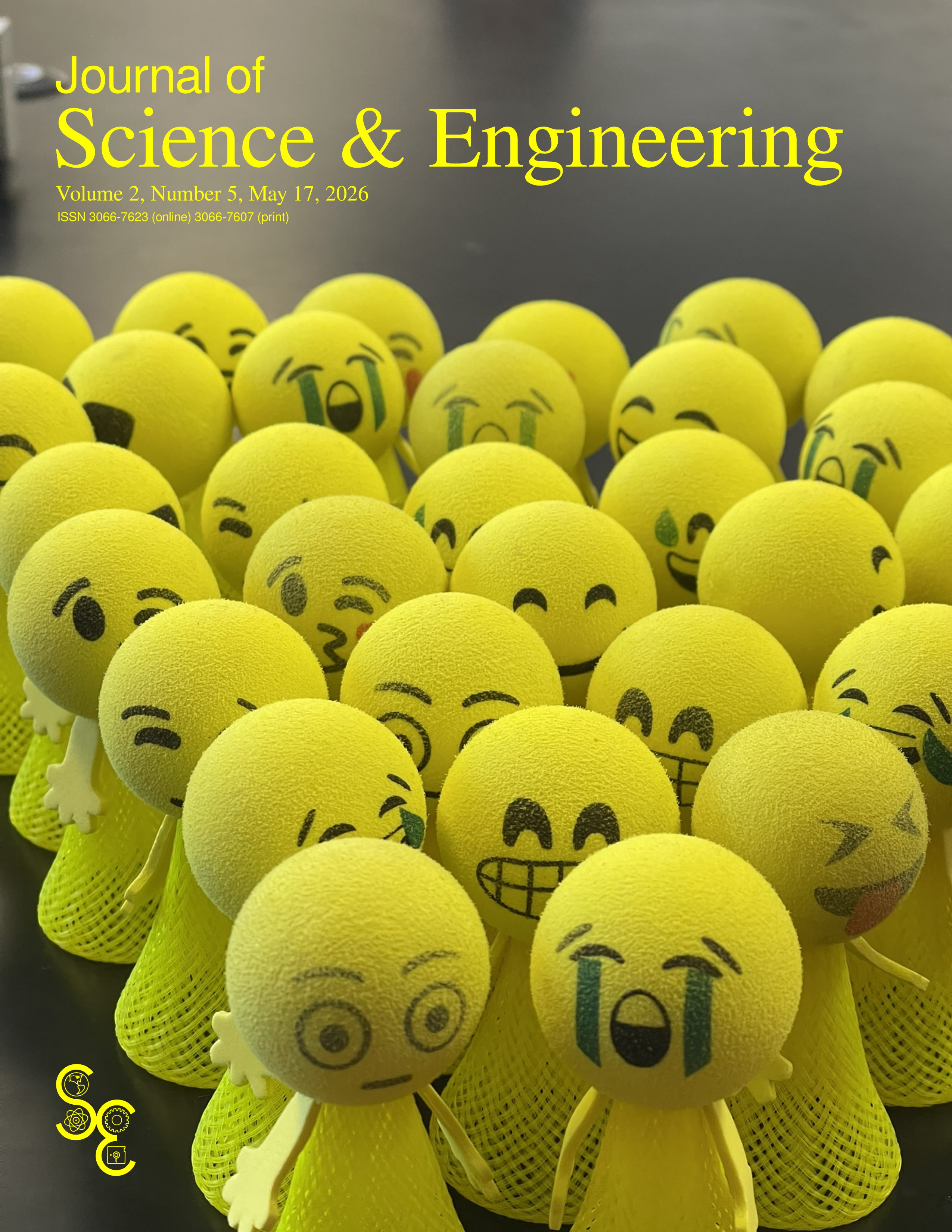
This experiment investigates whether the facial expression of a popper affects its maximum jump height using principles of energy conservation. Five “happy” poppers and five “sad” poppers were compressed to maximum depth and released, converting elastic potential energy into kinetic energy, and then gravitational potential energy. Elastic potential energy was measured via a force- compression graph (EPE = 294.0 mJ). Mean kinetic energy (KE) at launch was 94.1 mJ (happy) and 81.4 mJ (sad), representing approximately 32% and 28% of stored EPE respectively. Paired t-tests confirmed that KE at launch and GPE at peak were not significantly different within either group (happy: p = 0.41; sad: p = 0.43), verifying that mechanical energy is conserved during flight. Two-sample t-tests found no statistically significant difference in mass (p = 0.12) or height (p = 0.24). These results support the hypothesis that facial expression does not affect energy transfer, and that popper motion is governed by elastic properties and mass rather than surface design.
References
P. A. Tipler and G. Mosca, Physics for Scientists and Engineers, 5th ed. (W H Freeman and Company, New York, 2004).
R. A. Pelcovits and J. Farkas, Barron’s AP Physics C Premium (Kaplan North America, Fort Lauderdale, FL, 2024).
W. Moebs, S. J. Ling, and J. Sanny, University Physics, Vol. 1 (OpenStax, Houston, TX, 2016).
N. Badmin, A. Dolgin, J. Khabinskiy, K. Koping, and E. Pechersky, Investigation of free fall using bottles of water and rocks, Journal of Science & Engineering 2, 32 (2026). DOI: https://doi.org/10.64804/ba7cpz93
C. Chazot and U. Delabre, Using smartphones to perform kinematic analysis in sports with the FizziQ app: example of the pole vault, The Physics Teacher 63, 791 (2025). DOI: https://doi.org/10.1119/5.0174195
R. Larson and R. P. Hostetler, Calculus, 8th ed. (Brooks Cole, Pacific Grove, CA, 2005).
R Core Team, R: A Language and Environment for Statistical Computing, R Foundation for Statistical Computing, Vienna, Austria (2025).
D. S. Starnes, J. Tabor, D. Yates, and D. S. Moore, ThePractice of Statistics, 5th ed. (W. H. Freeman and Company, 2015).
H. Wickham, ggplot2: Elegant Graphics for Data Analysis (Springer-Verlag New York, 2016). DOI: https://doi.org/10.1007/978-3-319-24277-4_9
H. Wickham, R. François, L. Henry, K. Müller, and D. Vaughan, dplyr: A Grammar of Data Manipulation (2026), R package version 1.2.0.
D. A. Faux and J. Godolphin, Manual timing in physics experiments: error and uncertainty, American Journal of Physics 87, 110 (2019). DOI: https://doi.org/10.1119/1.5085437
D. Brown, R. Hanson, and W. Christian, Tracker video analysis and modeling tool (2025), version 6.3.3.
J. A. Simeonov, The coefficient of normal restitution for the Hertzian contact of two rough spheres colliding in a viscous fluid, Mechanics Research Communications 73, 140 (2016). DOI: https://doi.org/10.1016/j.mechrescom.2016.02.017
A. Sendrowicz, A. O. Myhre, I. S. Yasnikov, and A. Vinogradov, Stored and dissipated energy of plastic deformation revisited from the viewpoint of dislocation kinetics modelling approach, Acta Materialia 237, 118190 (2022). DOI: https://doi.org/10.1016/j.actamat.2022.118190
Downloads
Published
Data Availability Statement
Data and analysis code are available at https://github.com/devangel77b/427syellapragada-lab3
Issue
Section
License
Copyright (c) 2026 Journal of Science & Engineering

This work is licensed under a Creative Commons Attribution-NonCommercial 4.0 International License.
How to Cite