
Examining energy storage and work done by elastic jumping poppers
DOI:
https://doi.org/10.64804/72j31w22Keywords:
mechanics, energy, conservation, work, physics, poppersAbstract
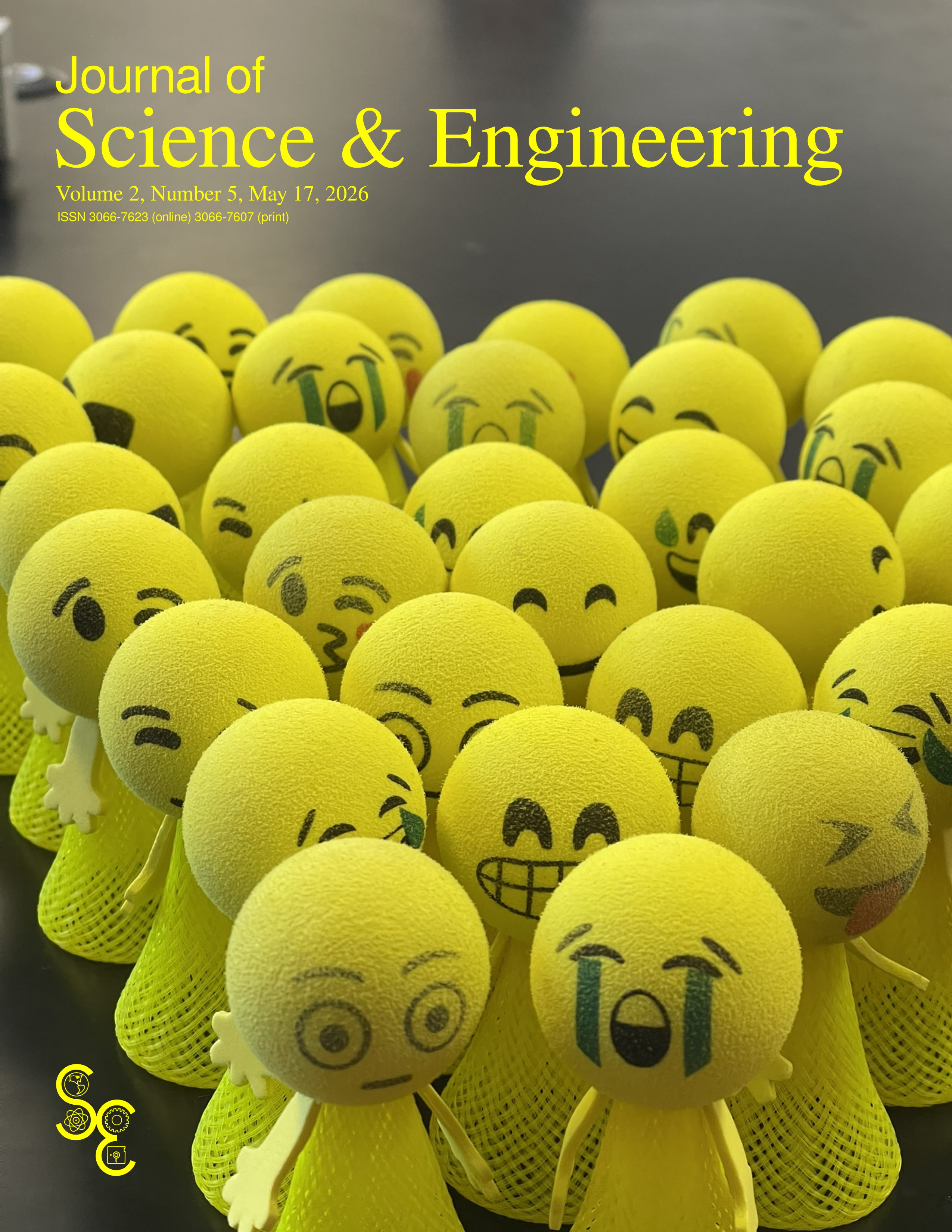
This experiment investigated energy storage and work done in elastic jumping poppers as nonlinear elastic systems. The maximum gravitational potential energy during launch was determined from video analysis, while force–displacement measurements obtained during compression were numerically integrated to calculate the work done on each popper. The force–displacement data revealed nonlinear elastic behavior characterized by snap-through instability. The measured launch energies were lower than the work calculated from compression measurements, indicating that although the poppers clearly stored and released elastic energy, the two methods did not produce close quantitative agreement under the conditions of this experiment.
References
P. A. Tipler and G. Mosca, Physics for Scientists and Engineers, 5th ed. (W H Freeman and Company, New York, 2004).
R. A. Pelcovits and J. Farkas, Barron’s AP Physics C Premium (Kaplan North America, Fort Lauderdale, FL, 2024).
W. Moebs, S. J. Ling, and J. Sanny, University Physics, Vol. 1 (OpenStax, Houston, TX, 2016).
J. A. Simeonov, The coefficient of normal restitution for the Hertzian contact of two rough spheres colliding in a viscous fluid, Mechanics Research Communications 73,140 (2016). DOI: https://doi.org/10.1016/j.mechrescom.2016.02.017
A. Sendrowicz, A. O. Myhre, I. S. Yasnikov, and A. Vinogradov, Stored and dissipated energy of plastic deformation revisited from the viewpoint of dislocation kinetics modelling approach, Acta Materialia 237, 118190 (2022). DOI: https://doi.org/10.1016/j.actamat.2022.118190
M. Gomez, D. E. Moulton, and D. Vella, Critical slowing down in purely elastic ’snap-through’ instabilities, Nature Physics 13, 142 (2017). DOI: https://doi.org/10.1038/nphys3915
A. N. Gent and I. S. Cho, Surface instabilities in compressed or bent rubber blocks, Rubber Chemistry and Technology 72, 253 (1999). DOI: https://doi.org/10.5254/1.3538798
D. Halliday, R. Resnick, and J. Walker, Fundamentals of Physics, 10th ed. (John Wiley & Sons, Hoboken, NJ, 2014).
D. Brown, R. Hanson, and W. Christian, Tracker video analysis and modeling tool (2025), version 6.3.3.
J. Renika, E. C. Prima, and A. Amprasto, Kinematic analysis on accelerated motion using Tracker video anal-ysis for educational purposes, Momentum Physics Education Journal 8, 23 (2024). DOI: https://doi.org/10.21067/mpej.v8i1.8883
M. Levine, D. Khettry, K. Coulanges, and R. A. A. Dela Rosa, Acceleration is constant during free fall, Journal of Science & Engineering 2, 41 (2026). DOI: https://doi.org/10.64804/x5ey9355
S. Dakwale, S. Hein, R. Wallace, and S. Yellapragada, The effect of initial vertical position on velocity at which an object strikes the ground, Journal of Science & Engineering 2, 35 (2026). DOI: https://doi.org/10.64804/sstdbq08
I. Sharma, B. DeMairo, and A. Liddawi, Analyzing Gallileo’s distance-time relationship for rolling motion on an inclined plane, Journal of Science & Engineering 2, 38 (2026). DOI: https://doi.org/10.64804/yzsmqz88
O. Ahmadzada, J. Pawelek, M. Butch, and T. Chung, Downward acceleration is independent of mass during free fall, Journal of Science & Engineering 2, 44 (2026). DOI: https://doi.org/10.64804/h4k7fv51
A. Hallur, J. Chan, M. Reznik, P. Zlotnikov, and J. Tiboni, Objects fall with constant acceleration regardless of mass, Journal of Science & Engineering 2, 53 (2026). DOI: https://doi.org/10.64804/hsepny74
L. Brunie, J. Kadan, E. Sobel, and T. Ramesh, Testing the independence of gravitational acceleration from mass: a comparative analysis of free-falling objects near earth’s surface, Journal of Science & Engineering 2, 50 (2026). DOI: https://doi.org/10.64804/bbdgcp59
C. R. Harris, K. J. Millman, S. J. van der Walt, R. Gommers, P. Virtanen, D. Cournapeau, E. Wieser, J. Taylor, S. Berg, N. J. Smith, R. Kern, M. Picus, S. Hoyer, M. H. van Kerkwijk, M. Brett, A. Haldane, J. F. del Rı́o, M. Wiebe, P. Peterson, P. Gérard-Marchant, K. Sheppard, T. Reddy, W. Weckesser, H. Abbasi, C. Gohlke, and T. E. Oliphant, Array programming with numpy, Nature 585, 357 (2020). DOI: https://doi.org/10.1038/s41586-020-2649-2
P. Virtanen, R. Gommers, T. E. Oliphant, M. Haberland, T. Reddy, D. Cournapeau, E. Burovski, P. Peterson, W. Weckesser, J. Bright, S. J. van der Walt, M. Brett, J. Wilson, K. J. Millman, N. Mayorov, A. R. J. Nelson, E. Jones, R. Kern, E. Larson, C. J. Carey, İ. Polat, Y. Feng, E. W. Moore, J. VanderPlas, D. Laxalde, J. Perktold, R. Cimrman, I. Henriksen, E. A. Quintero, C. R. Harris, A. M. Archibald, A. H. Ribeiro, F. Pedregosa, P. van Mulbregt, and SciPy 1.0 Contributors, scipy 1.0: fundamental algorithms for scientific computing in Python, Nature Methods 17, 261 (2020). DOI: https://doi.org/10.1038/s41592-020-0772-5
J. D. Hunter, matplotlib: a 2D graphics environment, Computing in Science & Engineering 9, 90 (2007). DOI: https://doi.org/10.1109/MCSE.2007.55
R. Larson and R. P. Hostetler, Calculus, 8th ed. (Brooks Cole, Pacific Grove, CA, 2005).
B. N. J. Persson, Rubber friction: role of the flash temperature, Journal of Physics: Condensed Matter 18, 7789 (2006). DOI: https://doi.org/10.1088/0953-8984/18/32/025
Y. Forterre, J. M. Skotheim, J. Dumais, and L. Mahadevan, How the Venus flytrap snaps, Nature 433, 421 (2005). DOI: https://doi.org/10.1038/nature03185
S. Timoshenko and J. M. Gere, Theory of Elastic Stability, 2nd ed. (McGraw-Hill, New York, 1961).
A. F. Arrieta, P. Hagedorn, A. Erturk, and D. J. Inman, A piezoelectric bistable plate for nonlinear broadband energy harvesting, Applied Physics Letters 97, 104102 (2011). DOI: https://doi.org/10.1063/1.3487780
Downloads
Published
Data Availability Statement
Data and analysis code are available at https://github.com/devangel77b/427bdemairo-lab3
Issue
Section
License
Copyright (c) 2026 Journal of Science & Engineering

This work is licensed under a Creative Commons Attribution-NonCommercial 4.0 International License.
How to Cite