
Highlights

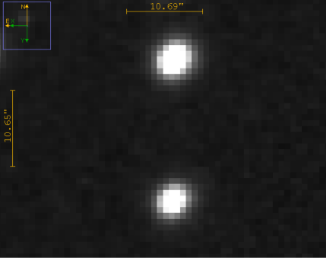
  1. WDS 18573+0302 from Arunkumar and Hilburn, 2026, Astrometric observations of WDS 18574+0302 UC 242 using the Great Basin Observatory. The Journal of Double Star Observations 22(4):386

    Arunkumar and Hilburn (2026). Astrometric observations of WDS 18574+0302 UC 242 using the Great Basin Observatory. The Journal of Double Star Observations 22(4):386.

    Binary stars are two stars known to orbit each other and are gravitationally bound to one another. However, verifying that a pair of stars from Earth is difficult: from our view, two stars may appear to be moving together, when in reality, they may be light-years apart. The purpose of this paper was to attempt to verify one such pair, code named WDS 18574+0302 by the Washington Double Star Catalogue. This research was conducted in cooperation with the Great Basin Observatory in Baker, NV as well as accessing data from the European Space Agency's Gaia DR3. We found that the pair of stars appear to be moving together in space, but that they are very unlikely to be within one light-year of one another. As such, we concluded that the pair may not be physically bound and that more observations may be needed to verify this pair.

    Read More

About the Journal

Journal of Science & Engineering (J S&E) publishes high quality, peer-reviewed, original research, short articles, articles, letters, and reports by promising students of science and engineering.  J S&E is a publication of the Freehold Regional High School District Press. Our online ISSN is 3066-7623 and our print ISSN is 3066-7607. Metadata and digital object identifiers (DOI) are registered with Crossref. J S&E is an open access journal.  J S&E currently publishes 4-6 issues per academic year. 

Current Issue

Vol. 2 No. 10 (2026)
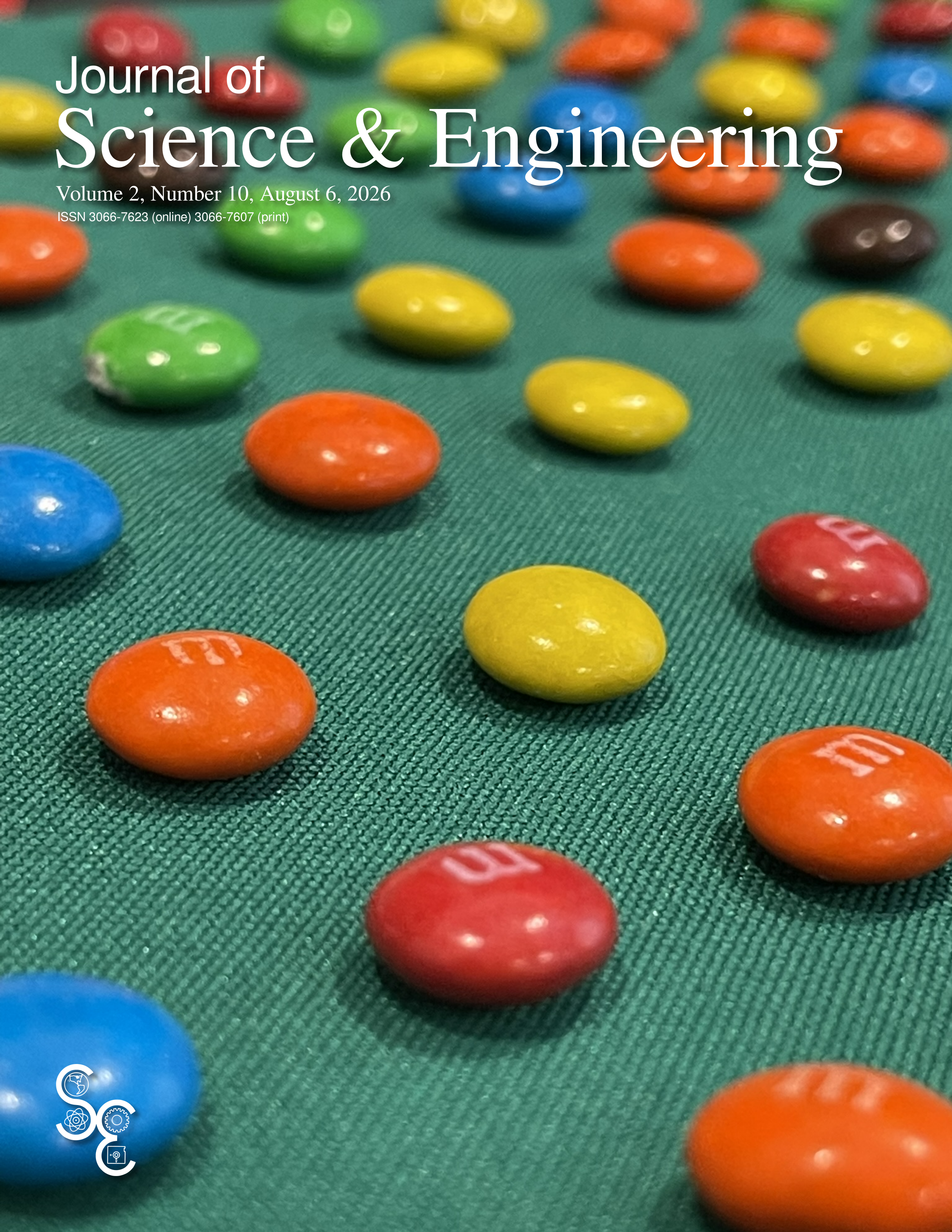
Colorful image of M&Ms in a regular rectangular grid on top of a green fabric. The image is meant to evoke ideas of different colors of quarks on a spacetime lattice as imagined during lattice quantum chromodynamics.

From the cover: Lattice quantum chromodynamics (QCD) is a physics tool which discretizes the continuous world onto a 4D spacetime lattice. In this issue, David Pevzner describes his independent research to simulate lattice QCD, using Markov chain Monte Carlo methods to evaluate the pion correlation function. The Gell-Mann-Oakes-Renner relation states that the squared pion mass should be proportional to the sum of the masses of the up and down quarks; Pevzner tests this relationship computationally. Quarks are tiny, fundamental building blocks of matter and combine to form larger subatomic particles. In the cover image, the array of milk chocolate M&Ms evokes the idea of the lattice, while the colors allude to the types and colors of quarks. Cover image: Dennis Evangelista.

Published: 2026-08-06
View All Issues